
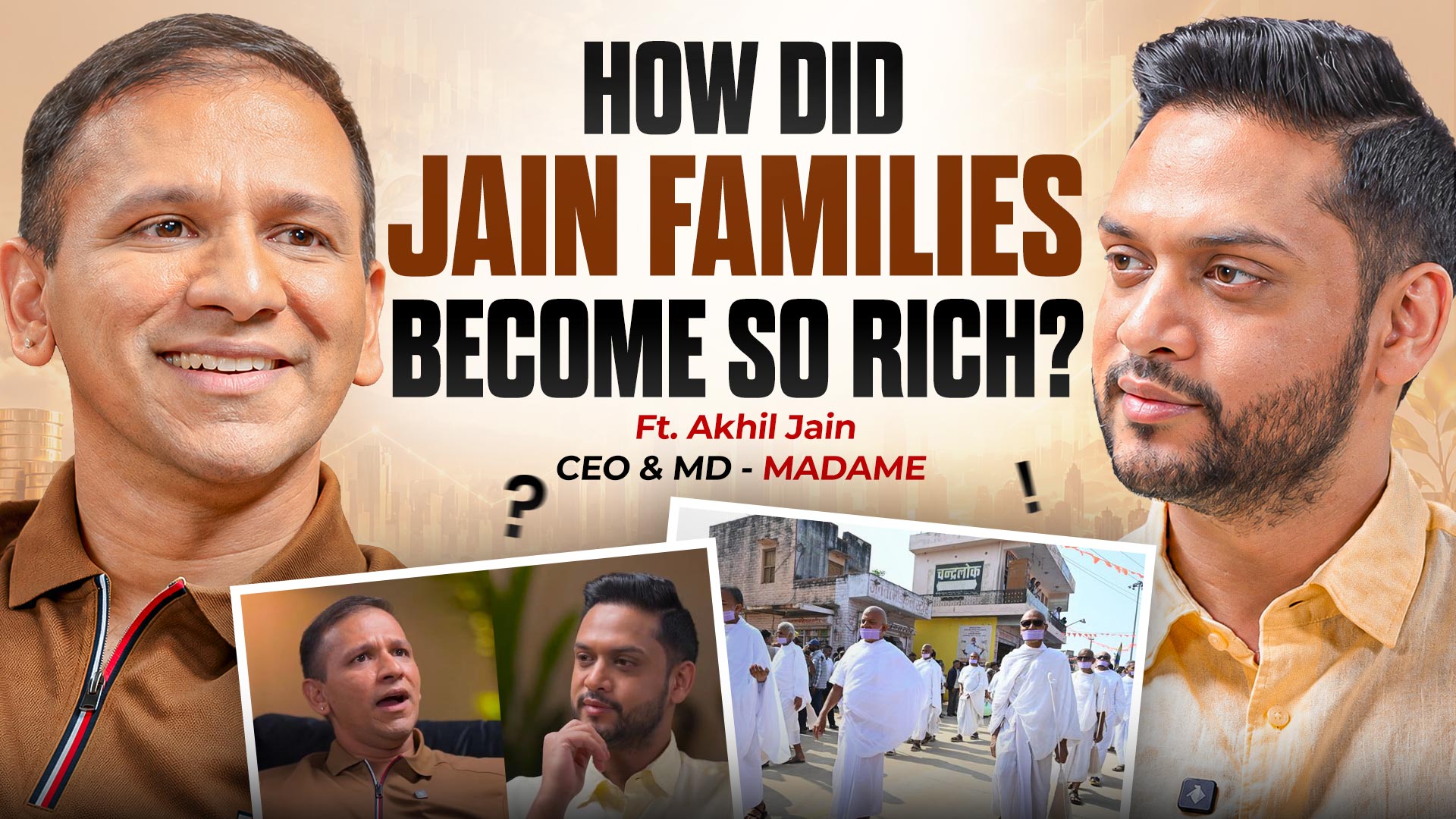
There are some conversations where you finish an interview with a list of answers.
And then there are conversations where you finish with stories.
My conversation with Akhil Jain was firmly in the second category.
What struck me most about Akhil was not just the scale of the business he represents, or the decades of family history behind Madame. It was his ability to take almost any business question and turn it into a story — a story about people, family, decisions, mistakes, resistance, ambition and change.
In fact, by the end of the conversation, I felt that perhaps the most interesting way to understand Akhil is not simply as the CEO and MD of Madame, but as a master storyteller who happens to run a large family business.
And his stories go much further back than Madame.
He took me back to the 1930s, to Kasur and then Ludhiana, to a family that began by manufacturing mufflers. That eventually became the origin of what the family calls the “Muffler Man” story. What I found fascinating was the importance Akhil attaches to preserving these stories.
For him, business history isn’t just about numbers.
It is about remembering where the family came from.
That became a recurring theme throughout our conversation.
At one point, I asked him about the values he believes have helped the Jain community flourish. His answer wasn’t a conventional business-school response. He spoke about aparigraha — being content whether you have less or more — about controlled spending and avoiding wastage, and most importantly, about community.
Then he illustrated those ideas through business.
Centralisation. Shared resources. Keeping families together. Building institutions. Creating networks that help the next generation.
Suddenly, what could have been a conversation about community values became a lesson in business economics.
That is Akhil’s storytelling style.
He rarely gives you an isolated answer.
He gives you a story that makes the answer memorable.
The same thing happened when we spoke about his journey into the family business.
What I found interesting was his almost obsessive attitude towards learning. He spoke about NIFT, internships, libraries, trying to study further, repeatedly looking for opportunities to learn outside the immediate family business.
When I asked him where that energy came from, there wasn’t some grand, rehearsed philosophy.
It sounded much more instinctive.
He simply wanted to learn.
And that curiosity eventually became one of the defining characteristics of his career.
But perhaps the most revealing stories were the ones involving his father.
Coming into a family business can give the next generation access to almost everything — except sometimes the freedom to skip the basics.
Akhil’s father made sure he didn’t.
Instead of giving him a glamorous role, he was pushed towards the ground level of the business: understanding inventory, serving customers, handling merchandise and learning how the operation actually worked.
It was, in many ways, a lesson in humility.
And years later, that same relationship evolved into something very different.
The son who once had to learn the business from the ground up eventually became the person pushing the organisation towards ERP systems, barcoding, RFID and newer ways of operating.
That transition wasn’t easy.
Akhil spoke candidly about the resistance that came from people who had been doing things the same way for years.
The old system worked.
The relationships worked.
The trust worked.
So why change?
His answer was simple: because a business can survive on personal trust at a certain scale, but it cannot necessarily build a ₹1,500-crore organisation that way.
That line stayed with me.
Because it explains something much bigger about family businesses: the very people who helped build the business can sometimes become the people who resist changing it.
And then came the story of 2016.
The Income Tax raid could easily have been presented as a dramatic business crisis.
Instead, Akhil walked me through what happened — the systems, the documentation, the pressure and the way the family responded.
Again, it wasn’t just an incident.
It became a story about how a company behaves when the environment around it becomes uncertain.
And that, perhaps, is what I enjoyed most about speaking to him.
Whether he was talking about his grandfather, the origins of Madame, family dynamics, technology, retail, organisational change or the future generation, he kept bringing the conversation back to people.
There was another story that stayed with me.
Akhil spoke about the size of a family growing while the economic “pie” remains limited.
When the pie is large, everyone can coexist comfortably.
When it becomes smaller relative to the number of people sharing it, comparison begins.
Main itni mehnat kar raha hoon. Woh kyun nahi kar raha?
That is how confrontation begins.
It is a remarkably simple way of explaining one of the most complicated problems in family businesses.
And perhaps that is Akhil’s real strength as a storyteller.
He takes complicated ideas and gives them an image.
A pie.
A store room.
A muffler.
A barcode scanner.
A raid.
A family dinner.
Suddenly, business strategy becomes something you can see.
After our conversation, I came away with the feeling that Akhil Jain’s story is not simply the story of a third-generation entrepreneur taking a legacy business forward.
It is a story about what happens when tradition meets scale.
When relationships meet governance.
When instinct meets systems.
When a family business has to evolve without losing the family that built it.
And most importantly, it is a reminder that sometimes the best way to understand a business leader is not through their designation or their balance sheet.
It is through the stories they choose to tell.
Akhil Jain has a lot of them.